Hand Lettering Pens for Beginners: Which Type to Use When
A plain guide to pen types for lettering, from pencil and fineliner to markers, brush pens and the water brush: the line each one makes, the styles it suits and which two to start with.
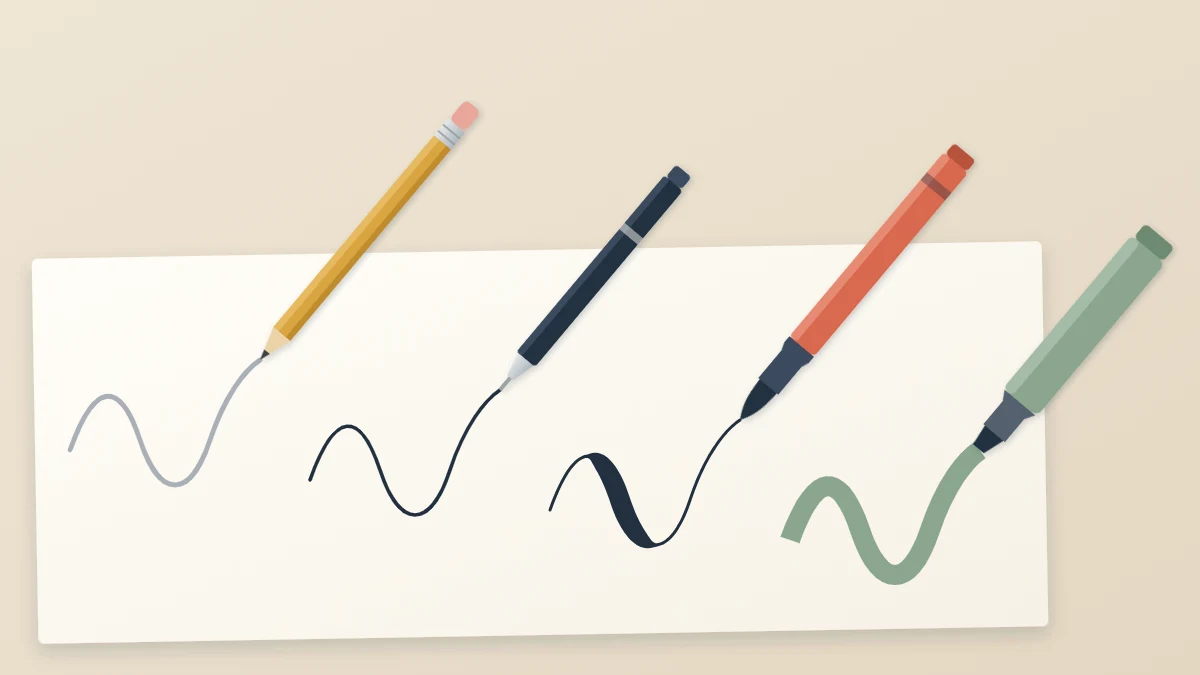
The pen aisle is confusing when you are new. Dozens of tools look alike, and the packaging rarely says what kind of line each one makes. The good news is that hand lettering pens fall into a small number of types, and each type behaves in a predictable way.
This guide sorts them by tip, not by brand. For every type you will find the line it makes, the styles it suits and how it feels in a beginner’s hand. Once you can recognize the tip, you can judge almost any pen.
Two kinds of line
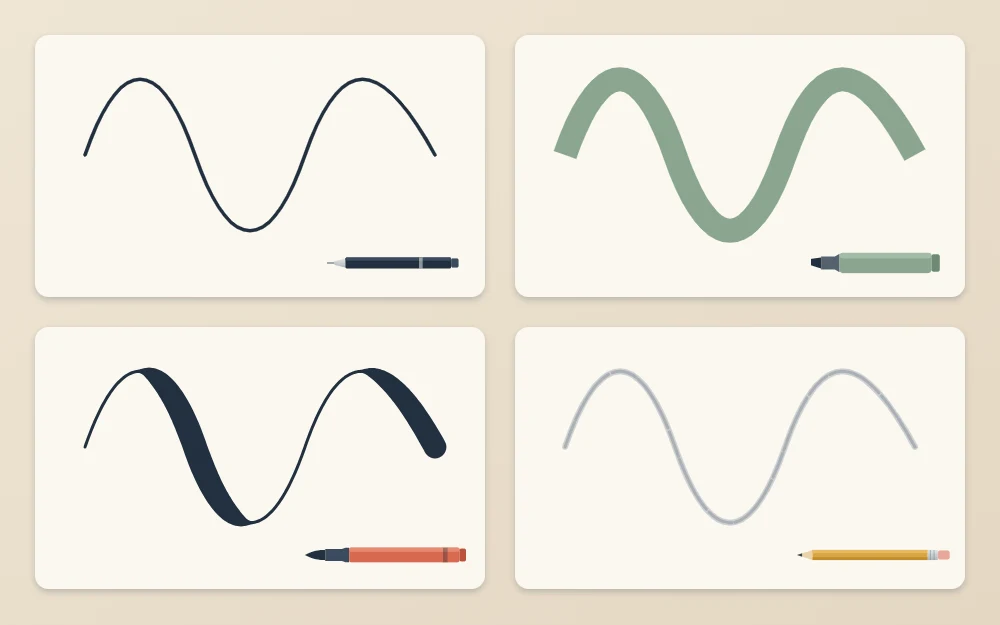
Every lettering tool does one of two things. It either makes a line of one fixed width, or it makes a line whose width changes as you write.
Fixed-width tools include pencils, fineliners, gel pens and bullet-tip markers. However you hold them, the line stays about the same. With these, any thick stroke has to be drawn: you outline it and fill it in, as in faux calligraphy and block letters.
Variable-width tools have a flexible tip. A brush pen makes a thin line with a light touch and a thick line when you press down. A chisel-tip marker sits between the two groups: its tip is rigid, but its line changes with the direction of the stroke.
Pencil
An HB or 2B pencil makes a soft gray line that erases cleanly. It is the tool for guide lines, skeletons and every sketch that comes before ink. It also works on its own for practice, since mistakes cost nothing.
It suits every style, because every style starts as a sketch.
Fineliner
A fineliner has a narrow plastic or fiber tip that makes a crisp, even, dark line. Fineliners come in several tip widths, from hair-thin to about 1/32 in (0.8 mm). A medium width, around 0.4 to 0.5 mm, is the most useful single size.
It suits monoline lettering, faux calligraphy, serif and sans serif styles, outlines of block letters and small details. Fineliners are easy to control and behave the same way every time, which is why one of them makes a good first ink pen. The tip is delicate, so use a light touch; pushing hard bends it and does not make the line any thicker.
Gel and rollerball pens
These have a small ball in the tip and lay down wet, smooth ink in an even line. They glide more easily than a fineliner, which some people find pleasant and others find slippery.
They work well for monoline practice. The ink takes longer to dry, so smudging is the main risk. A white gel pen is a useful extra later, for highlights on dark letters.
Bullet-tip and chisel-tip markers
A bullet-tip marker has a rounded tip and makes a bold, even line, like a thick fineliner. It is ideal for large monoline words, filling in block letters and signs, and it is one of the easiest tools to use.
A chisel-tip marker has a flat, slanted edge. Pulled downward on its wide edge, it makes a broad stroke; moved sideways along its thin edge, it makes a narrow one. The contrast comes from holding the tip at a constant angle, not from pushing harder. It suits bold sans serif and slab-style capitals. Keeping the angle steady takes some practice, so most beginners come to it after the bullet tip.
Brush pens and the water brush
A brush pen has a flexible, pointed tip. With a brush pen, a light touch gives a thin upstroke and firm pressure gives a thick downstroke, all in one movement. That is the look of modern brush script.
Small firm-tip brush pen
The tip is short and springs back quickly. It makes modest contrast between thick and thin and suits small lettering, with an x-height of roughly 1/4 to 3/8 in (6 mm to 1 cm). Because the tip resists your hand a little, it is the most manageable brush pen to learn with.
Large soft-tip brush pen
The tip is long and bends easily, so a small change in pressure makes a large change in the line. Strokes can be very thick, which suits large lettering with an x-height of 3/4 in (2 cm) or more. It is expressive but harder to control, and wobbles show clearly.
Water brush
A water brush has real or synthetic bristles and a barrel you fill with water or diluted ink. It behaves like a soft paintbrush: the most flexible of the three and the least predictable. It is worth trying once brush pens feel comfortable.
All three depend on the same skill, which is covered in the guide to controlling pen pressure for thick and thin strokes.
Common mistake
Buying a large soft brush pen first because it looks the most like lettering. It is the hardest tool here to control. Shaky results at that stage usually come from the tool, not from you.
Pen types compared
| Type | Line | Suits | For a beginner |
|---|---|---|---|
| Pencil | Soft, even, erasable | Sketches, guide lines, all styles | Essential |
| Fineliner | Thin, even, crisp | Monoline, faux calligraphy, serifs, outlines | Very easy |
| Gel or rollerball | Even, wet, smooth | Monoline, highlights | Easy; smudges |
| Bullet-tip marker | Broad, even | Large monoline, filling block letters | Very easy |
| Chisel-tip marker | Broad or narrow by direction | Bold capitals, signs | Moderate |
| Small firm brush pen | Thick and thin, modest contrast | Small brush script | Moderate |
| Large soft brush pen | Thick and thin, strong contrast | Large brush script | Harder |
| Water brush | Very variable | Loose, painted lettering | Harder |
Which pens to start with
Start with a pencil and one medium fineliner. With those two you can learn guide lines, letter shapes, spacing, monoline lettering and faux calligraphy, which together cover most of what a beginner needs. The full short list, including the eraser and ruler, is in the guide to a simple starter kit.
Add a bullet-tip marker when you want bolder words. Add a small firm-tip brush pen when your letter shapes are steady and you are curious about brush script. Leave the large soft brush pen and the water brush until the small one feels familiar.
Whatever you choose, cap each pen as soon as you put it down and use smooth paper. Rough paper wears down fineliners and frays brush tips; the article on choosing paper for lettering practice explains what to look for.
Left-handed readers meet smudging more often, because the hand follows the pen across fresh ink. Faster-drying fineliners, a scrap sheet under the hand and turning the paper slightly all help.
Frequently asked questions
What is the best pen for a complete beginner in hand lettering?
A pencil for sketching and one medium fineliner for ink. Both make a single even line, so you can concentrate on letter shapes and spacing without managing a flexible tip. They cover monoline lettering and faux calligraphy, which are the usual starting styles.
Do I need a brush pen to start hand lettering?
No. A brush pen is only needed for brush script, where one stroke changes from thin to thick. You can get a similar look with any even-line pen by drawing the thick downstrokes and filling them in. Many people add a small firm-tip brush pen after a few weeks of basics.
What is the difference between a bullet tip and a chisel tip?
A bullet tip is rounded and makes the same broad line in every direction. A chisel tip is flat and angled, so it makes a wide line when pulled along its broad edge and a narrow line along its thin edge. Bullet tips are simpler; chisel tips give bolder contrast.