A 15-Minute Daily Lettering Practice Routine for Beginners
A simple 15-minute session plan for busy beginners: warm-up strokes, one letter group, one word and a short review, plus a weekly rotation of focus.
Most beginners do not lack time so much as a plan. You sit down with a pen and twenty spare minutes, wonder what to work on, letter a favorite word twice, and stop. Nothing was wrong with the effort; it just had no shape.
A short lettering practice routine fixes that by deciding in advance what each minute is for. The one below takes about 15 minutes, needs only a pencil or pen and a notebook, and covers the three things that matter in every session: loosening up, repeating one thing on purpose, and looking back at what you made.
Why short and daily works better than long and rare
Lettering is partly a motor skill. Hands learn through frequent repetition, and they forget a little between sessions. A short session most days keeps the gap between repetitions small. One long session at the weekend leaves six days for the feeling of a good oval to fade.
Short sessions are also easier to start. If the plan asks for a quarter of an hour, you are more likely to begin on a tired evening, and beginning is the hard part. Missing a day is not a failure; simply pick up the next one.
The 15-minute plan
The times are rough guides, not a stopwatch exercise. Keep the order, and let the minutes stretch or shrink a little.
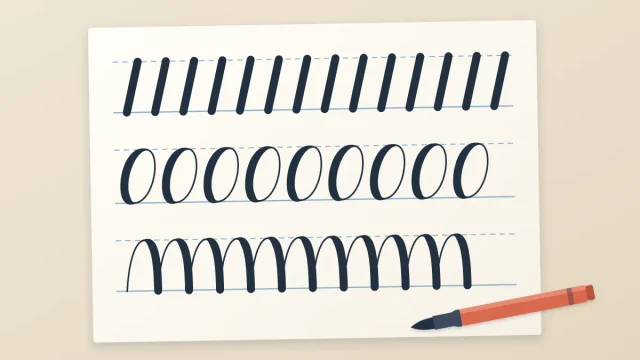
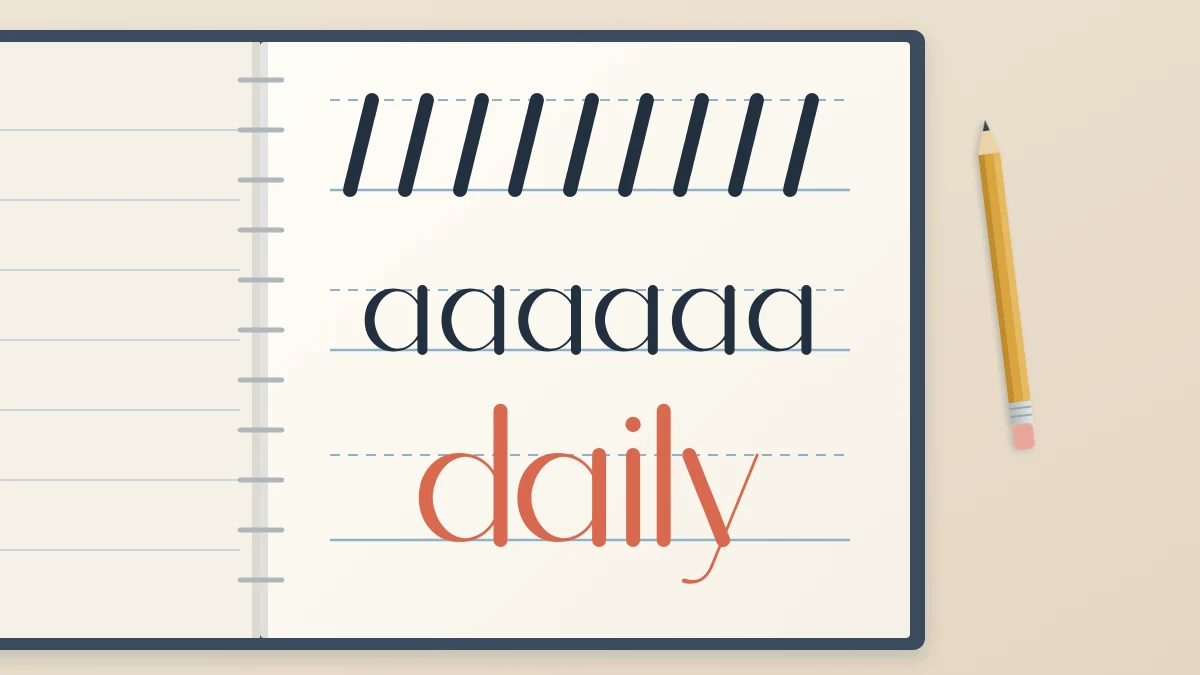
- Warm-up strokes, about 3 minutes. Fill two or three rows with simple shapes: parallel downstrokes, ovals, connected arches. The point is to settle your speed and grip before anything counts. Choose your rows from these warm-up drills for steady lines.
- One letter group, about 5 minutes. Pick a small group of related letters, such as the round ones (a, c, d, e, g, o, q) or the arch ones (h, m, n, r, u). Draw a row of each, slowly. Related letters share a shape, so fixing the oval in one improves all of them.
- One word, about 5 minutes. Choose a short word that uses the letters you just practiced and letter it three or four times. Change one thing between attempts: wider gaps, a taller x-height, a steadier slant. Do not start again from scratch each time; adjust.
- Review and date, about 2 minutes. Put the pen down. Look at the page from arm’s length, circle the best letter and the best word, and write one short note about what to try next time. Then write the date in a corner.
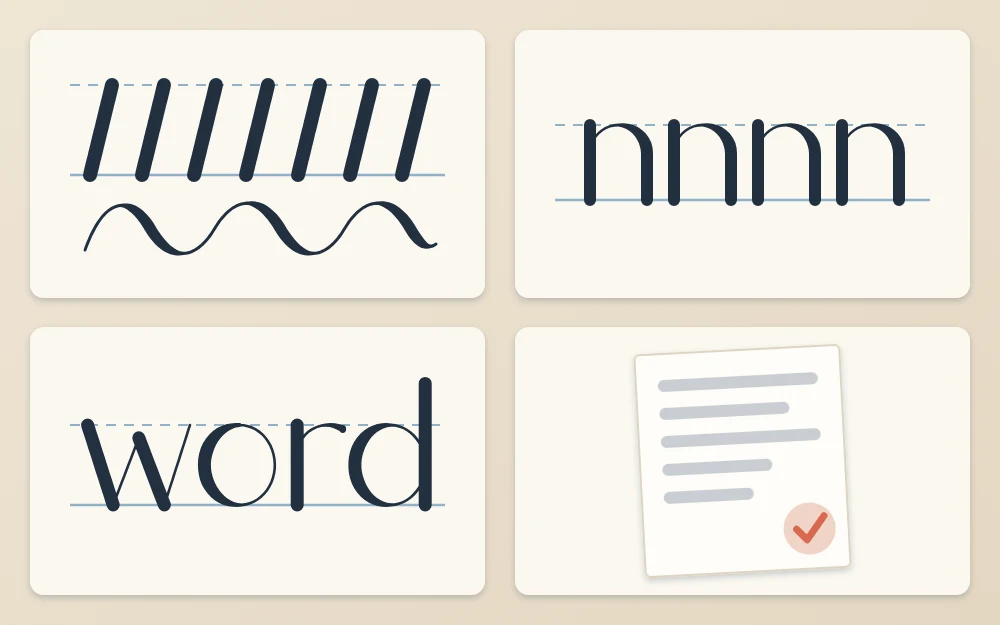
The final two minutes are the part people skip, and they are the part that turns repetition into practice. A page you never look at teaches your hand, but not your eye.
Tip
Leave your notebook open on the desk with the pencil on top. If setting up takes no effort, a short session is much more likely to happen.
A weekly rotation of focus
Doing the identical session every day gets dull, and dull practice becomes careless practice. Keep the four-part structure, but change what the two middle blocks are about. One possible week:
| Day | Focus | Middle blocks |
|---|---|---|
| 1 | Strokes | The basic strokes as rows, then a word built mostly from them, such as “minimum” |
| 2 | Lowercase | One letter family, then a word that uses it |
| 3 | Capitals | Five or six capitals, then a short word in all capitals |
| 4 | Spacing | One word lettered several times with the gaps adjusted each time |
| 5 | A style | One style, such as monoline or faux calligraphy, applied to familiar letters |
| 6 | A small composition | Two or three words arranged on two lines inside a pencil frame |
| 7 | Free day | Anything you like, or a rest |
The days do not need to match the calendar. If you practice four times a week, the rotation simply takes longer to come around, and that is fine.
Keep every page
Work in one notebook or keep loose sheets in a folder, in order, with the dates on them. Day to day, your lettering will look about the same, and some days it will look worse. Change only becomes visible when you put a page from several weeks ago next to today’s.
Looking back is also how you find patterns. If the same note appears three sessions running, for example “letters shrink toward the end of the word”, you have found your next focus. The guide to keeping size, slant and weight even gives specific fixes for that kind of problem.
If you are left-handed and work in ink, let each row dry before moving your hand across it, or rest your hand on a scrap sheet, so the pages you keep stay clean.
When to raise the difficulty
Stay at one level until most of a page looks alike, then change a single thing. Trying to change everything at once makes it hard to tell what helped.
- Move from pencil to pen, so lines can no longer be erased.
- Make the x-height smaller. Small letters hide less.
- Choose longer words, or words with awkward letter pairs.
- Replace the single word with a two-word phrase.
- Add a new style on the style day.
If a harder version makes every page fall apart, step back one level for a while. That is an adjustment, not a setback.
Honest expectations
Progress in lettering is gradual and uneven. Steadier lines and more even letter heights tend to come with weeks of regular short sessions, but the timing differs from person to person, and nobody can promise a date. Expect plateaus where nothing seems to change, and occasional bad days that say more about tiredness than about skill.
What the routine can reliably give you is a record: dated pages, a note on each, and a clear idea of what to work on next. When a page disappoints you and you cannot tell why, compare it with this list of common beginner lettering mistakes and choose one fix for tomorrow’s session.
A sample session, start to finish
Suppose it is a lowercase day. You draw two rows of ovals and one of connected arches. You then fill five rows with a, d, g, o and q, watching that every oval leans alike. Next you letter “good” four times, opening up the gaps on the third attempt. Finally you circle the second “g” and the third word, write “ovals too narrow at the end of each row”, and add the date. That is the whole session, and it is enough.
Frequently asked questions
Is 15 minutes a day really enough to improve at lettering?
For most beginners it is a useful amount, because regular short sessions keep the movements fresh. It will not produce fast results, and nobody can promise a timeline. Improvement tends to show slowly, when you compare dated pages several weeks apart. Longer sessions help only if your attention holds.
What should I do if I miss a few days of practice?
Simply start again with the next session and do not try to make up the lost time in one long sitting. Expect the first page back to feel a little stiff. An extra minute of warm-up strokes usually helps, and the rotation can continue from wherever you stopped.
Should I practice with a pencil or a pen?
A pencil is a good default at the beginning, because you can draw lightly, correct shapes and keep the page clean. Switching to a pen is one way to raise the difficulty later, since every line stays visible. Use whichever tool matches the style you are working on that day.