How to Draw Banners and Ribbons for Hand Lettering
Draw a straight ribbon banner from a rectangle, two end pieces and two fold triangles, then a wavy version from parallel curves. Includes how to fit a word inside and shade the folds.
Lesson at a glance
What you need
- HB or 2B pencil
- Soft eraser
- Ruler
- Fineliner pen
- Smooth paper
A ribbon behind a single word is one of the most useful small decorations in lettering. It gives a short line a home, separates it from the lines above and below, and fills space without adding more letters. Once you know how to draw a banner from a rectangle and two end pieces, the same construction works at any size.
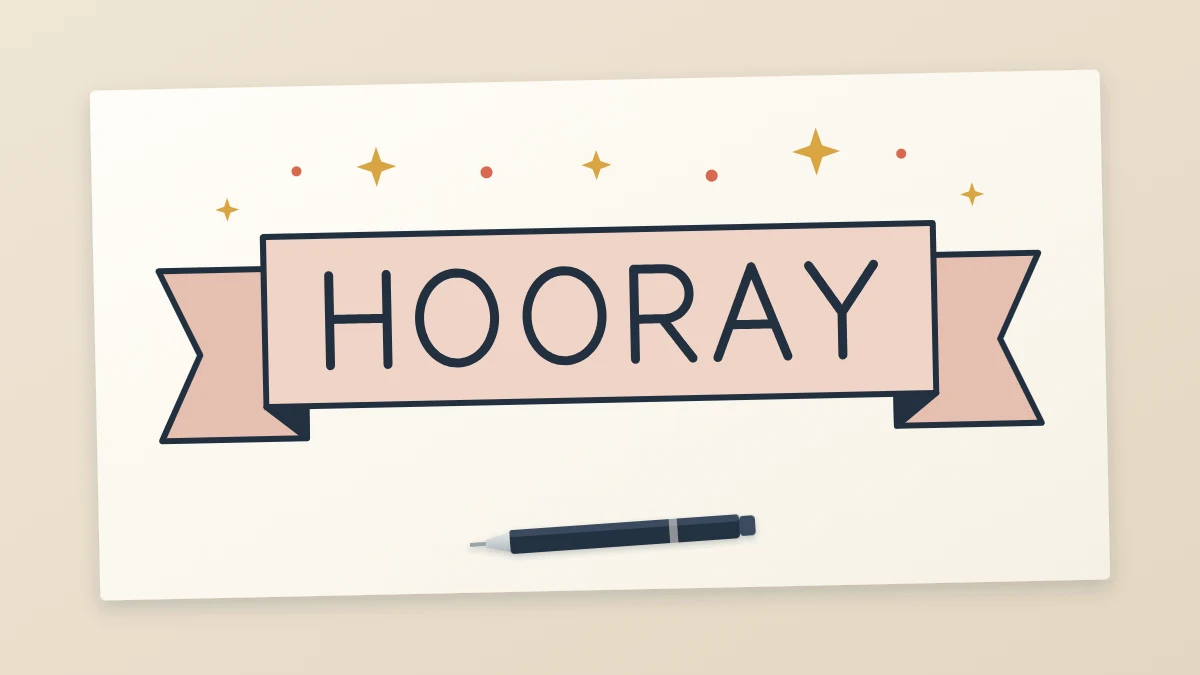
This tutorial builds a straight banner first, then a wavy one, and then covers fitting a word inside and shading the folds. The example word is “hooray”.
What you need
- An HB or 2B pencil and a soft eraser
- A ruler
- Smooth paper, or a dot grid pad if you have one
- A fineliner for the final outline
A first banner takes around 15 to 20 minutes. Draw lightly, because several construction lines are erased at the end; the guide to going from rough pencil sketch to final ink explains the habit.
How to draw a straight banner
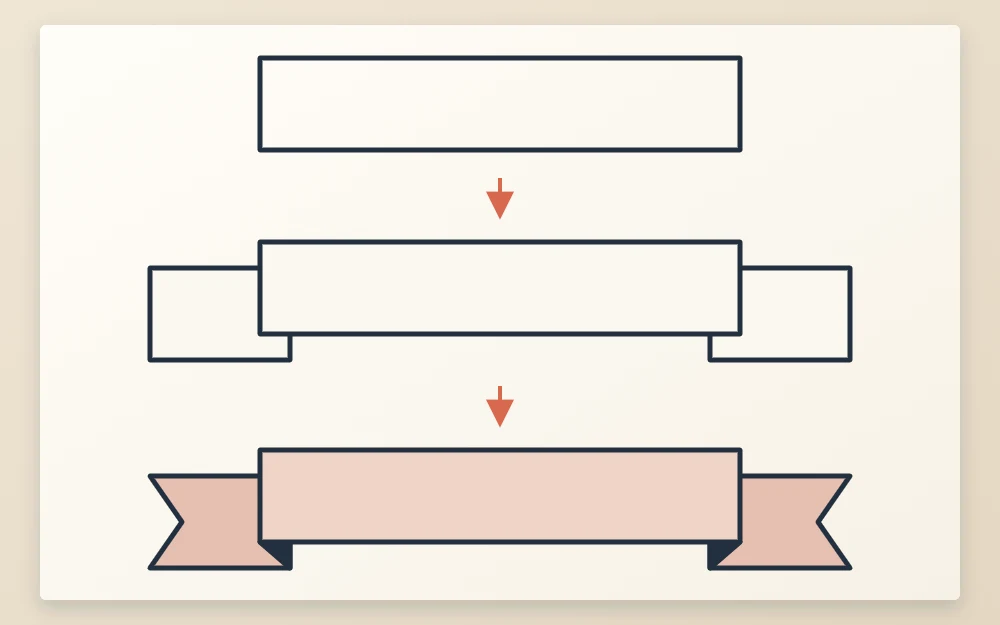
- Draw the center panel. Rule a rectangle about 4 in (10 cm) wide and 1 in (2.5 cm) tall. This is the front of the ribbon, where the word will go. Check that the top and bottom edges are parallel.
- Add the two end pieces. The ends sit lower than the panel and tuck behind it. On the left, draw a rectangle of the same height that starts about 1/4 in (6 mm) inside the panel’s left edge, sits 1/4 in lower than the panel, and extends about 3/4 in (2 cm) beyond the panel. Draw only the parts that fall outside the panel, since the rest is hidden behind it. Repeat on the right as a mirror image.
- Check the ends. Each end piece should now show as a block beside the panel plus a thin strip peeking out under the panel’s bottom corner. Both ends should drop by the same amount.
- Connect with fold triangles. At each bottom corner of the panel, draw a short diagonal from the corner down and inward to the inner bottom corner of the end piece. That diagonal closes a small triangle under the panel. It is the underside of the ribbon as it folds back.
- Notch the tails. On the outer edge of each end piece, mark the midpoint, then move that mark about 1/4 in toward the panel. Draw a line from the upper outer corner to the mark and another from the lower outer corner to the mark. Erase the original straight edge. The tail now ends in a V-shaped notch.
- Clean up. Erase any line of an end piece that crosses the panel. Fill the two fold triangles solid, or shade them darkly.
Common mistake
Drawing the end pieces level with the panel. Then there is no room for a fold triangle, and the banner reads as three flat boxes. Shift the ends by at least a quarter of the panel’s height.
How to draw a wavy banner
Here the panel is built from two parallel curves instead of a rectangle.
- Draw the top curve. Sketch one gentle wave about 4 in wide: it rises a little, dips a little and ends level with where it began. Keep the wave shallow, no more than about 1/4 in above and below a straight line.
- Draw the matching bottom curve. Make a row of light dots 1 in below the first curve, measuring straight down each time. Join the dots. Measuring straight down, not at right angles to the curve, is what keeps the ribbon looking like one even strip.
- Close the panel. Join the curves at each end with a short vertical line.
- Add the end pieces. Behind each end, draw a shorter strip that continues the direction of the wave, set lower on one side and higher on the other if you like. Connect each with a fold triangle and notch the tails exactly as before.
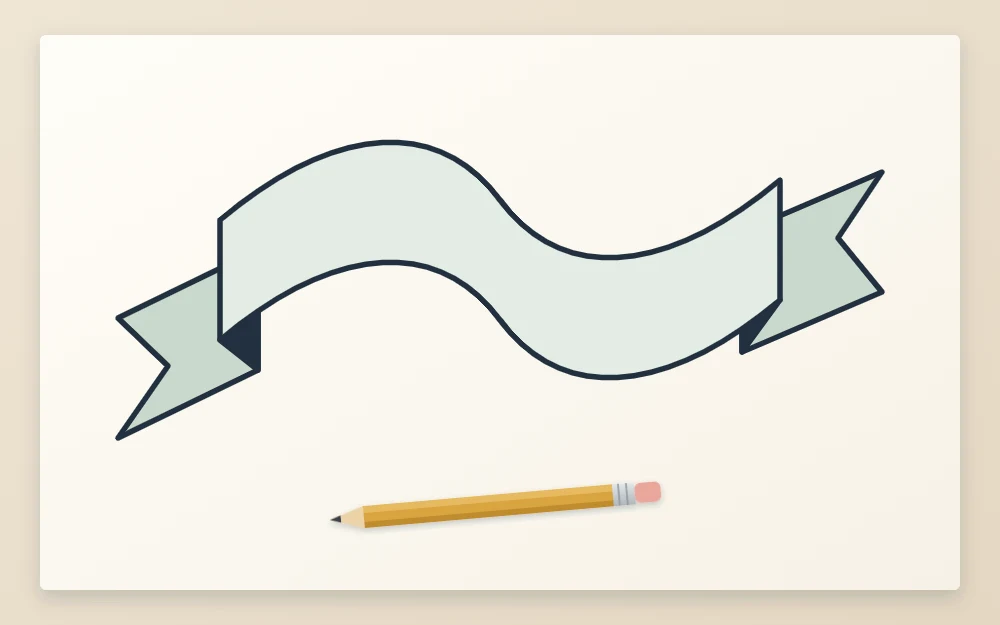
Check: the vertical distance between the curves should match at the left, the middle and the right.
Fitting the word inside
There are two ways to work, and both are worth trying.
Letter first
Sketch the word, then draw the panel around it. This suits beginners, because the banner always ends up the right length. Leave a gap on each side of about one letter width, and above and below of about a quarter of the letter height.
Banner first
When the banner has to fit a fixed space, draw it first. Then rule a baseline and a top line inside the panel, leaving the same margin above and below. Mark the center of the panel, place the middle of the word there, between the “o” and the “r” in “hooray”, and sketch outward in both directions.
Plain monoline capitals are the easiest letters to fit, because they all share one height.
Keeping letters upright on a curve
On a wavy banner, draw a curved baseline and top line that follow the ribbon. Each letter sits on the curve at its own spot, rising and falling with the wave, but its stems stay vertical. On a gentle wave, upright letters are easier to read and to draw than tilted ones.
Shading the folds
- Fold triangles: the darkest part. Fill them solid with the fineliner.
- End pieces: these sit behind the panel, so add a few short parallel lines on each one right next to the panel, where the panel would cast a shadow.
- Front panel: leave it clean so the word stays readable.
If you color the ribbon, use one light color for the panel and the same color, layered twice, for the end pieces. To give the letters depth as well, see adding drop shadows to lettering.
Tip
Ink the outline before you fill the triangles, and let it dry before erasing the pencil. Left-handed readers can ink the right end piece first and work toward the left, or turn the paper, to keep the hand off wet lines.
Variations to practice
Repeat the straight banner three times, changing one thing each time:
- Raise the end pieces above the panel instead of dropping them. The fold triangles move to the top corners.
- Cut the tails at a slant instead of notching them.
Then place a banner in a real piece, such as behind a short line in a stacked quote; the article on layout shapes for quotes shows where it fits. Early banners often come out lopsided. Measuring the drop of both end pieces fixes most of that, and steadier curves come gradually.
Frequently asked questions
Should I draw the banner or the word first?
For a single word with no fixed space, sketch the word first and build the banner around it, since the length will always fit. When the banner has to match the width of other lines in a piece, draw the banner first and center the word inside it from the middle outward.
Why does my banner look flat?
Usually the end pieces are level with the center panel or the fold triangles are missing. Set each end clearly lower or higher than the panel, connect the corners with a diagonal, and fill the small triangle that appears. That dark triangle is what tells the eye the ribbon folds back.
How do I keep a wavy banner the same width all along?
Draw the top curve, then measure straight down by the same distance at several points and mark a dot each time. Join the dots for the bottom curve. Checking the width at the left, middle and right before inking catches most pinched or swollen spots.